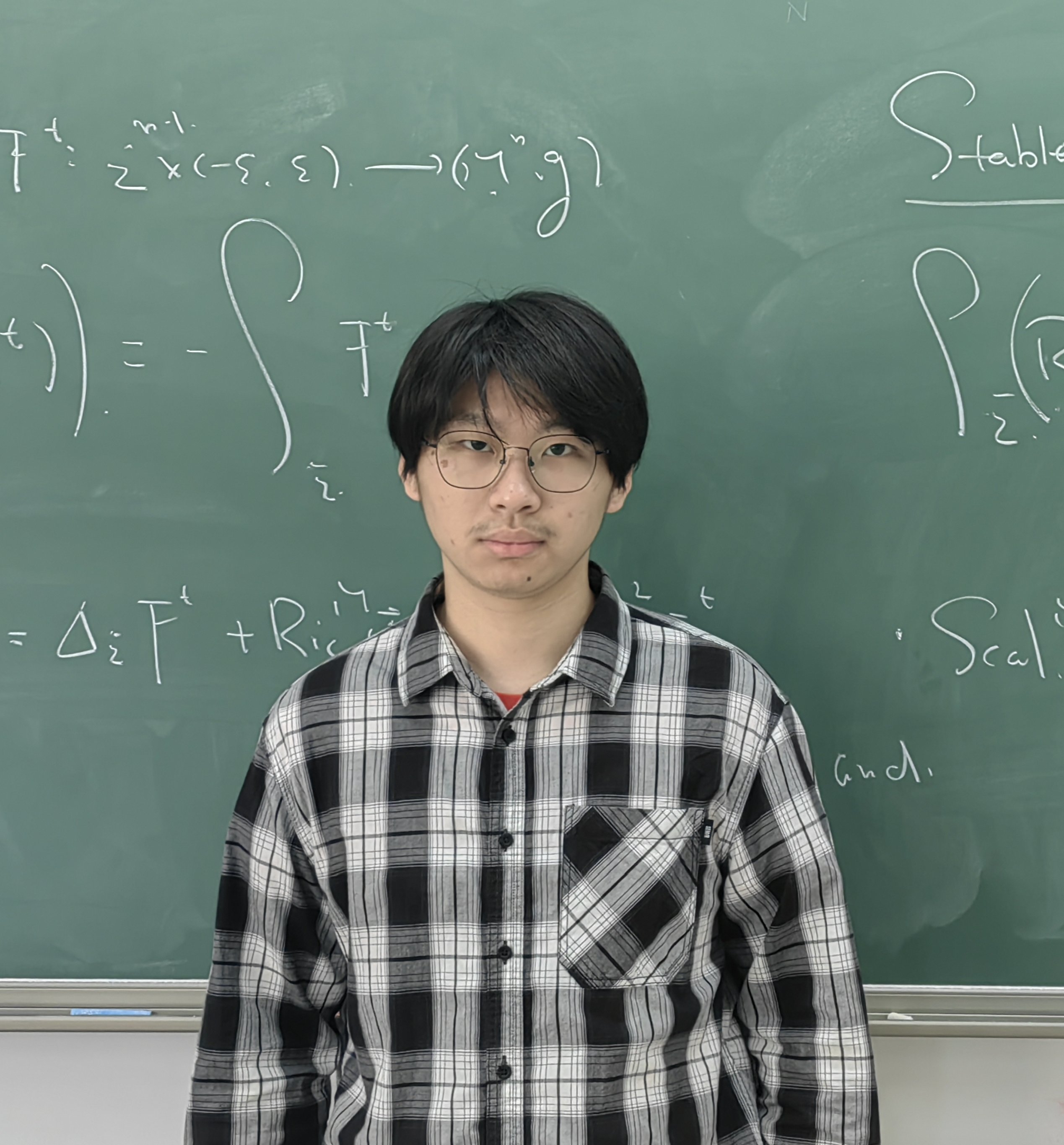
About Me
I was born in Zhejiang, China. I am currently a Ph.D. student in Mathematics at The Chinese University of Hong Kong, under the supervision of Professor Juncheng Wei.
Education
Personal Awards
Curriculum Vitae
You can view and download my complete CV here: Qian Zhenye's CV (PDF)
Research
Research Interests
Partial Differential Equations and Geometric Analysis, including nonlinear elliptic PDEs, fluid dynamics, geometric measure theory and curvature flow.
Recently, I was interested in following topics:
Elliptic PDEs
- [September 2025 – present, first part of my thesis] Studying qualitative properties of semilinear elliptic partial differential equations in unbounded domains, including monotonicity, symmetry, Liouville‑type theorems for certain Schrödinger operators, and energy estimates. This work is motivated by Berestycki, Caffarelli and Nirenberg (1997) and Alberti, Ambrosio and Cabré (2001). The research focuses on two main directions. The first concerns monotonicity of solutions to $\Delta u + f(u) = 0$ on the half‑space with $f$ merely locally Lipschitz. The case $f(0) \geq 0$ was completely resolved by Berestycki–Caffarelli–Nirenberg, while $f(0) < 0$ in dimension $n = 2$ was proved by Farina & Sciunzi (2017). The problem remains open for $f(0) < 0$ and $n > 2$, as discussed in Cortázar, Elgueta, García‑Melián's paper.
- [December 2025 – present, second part of my thesis] Studying the De Giorgi–Nash–Moser theory (1960s) for nonlinear elliptic equations and its geometric counterpart concerning ε‑regularity in geometric measure theory. For fully nonlinear equations, we examine the Krylov–Safonov theory, further developed by Caffarelli (1987) and Caffarelli & Lihe Wang (1993). Subsequently, Savin extended the theory to small‑perturbation settings (2007), whose techniques enable establishing a crucial Harnack inequality and lead to an improved flatness theorem—a refinement central to resolving the De Giorgi conjecture for dimensions $4 \leq n \leq 8$ under necessary assumptions.
Geometric Analysis
- [February 2026 – present, third part of my thesis] Studying the evolution of level sets under generalized mean curvature flow (MCF), focusing on well‑posedness, singularity formation, and applications to dynamic phase transition models such as the parabolic Allen–Cahn equation. The theory of generalized MCF (the classical formulation was pioneered by Hamilton [Ricci flow] in 1982 and Huisken in 1984) splits into two main approaches. The first, introduced by Brakke in 1978, uses geometric measure theory (motivated by Allard 1972) to construct varifold solutions and establish partial regularity. The second is the theory of viscosity solutions for the level‑set formulation, developed by many authors in the 1980s–1990s, including Evans, Crandall–Lions, Crandall–Evans–Lions, Lions, Jensen, and Ishii. Our work focuses on the seminal contributions of Evans–Spruck (“Motion of level sets by mean curvature” I–IV) and their applications to the Ginzburg–Landau model (see Evans–Soner–Souganidis and Chen–Giga–Goto in the 1990s).
- [January 2026 – present] Studying harmonic maps in geometric variational problems and elliptic PDE theory, with an emphasis on regularity and the structure of singularity sets. Key contributions include the foundational work of Schoen–Uhlenbeck, followed by the regularity theories developed by Evans, Hélein, Rivière, Fanghua Lin, Lin–Rivière, and more recently the quantitative stratification results of Naber–Valtorta.
- [September 2025 – present, lectures in the Minimal Surfaces Seminar] Studying the min‑max construction for minimal surfaces and more general geometric variational problems. The min‑max method traces back to Schwarz in the 1940s (for harmonic functions) and Birkhoff in the 1910s (for closed geodesics on 2‑spheres). Our focus is on its modern refinements, including Croke's work and the two seminal articles by Colding–Minicozzi that connect width to Ricci flow and mean curvature flow. For a comprehensive overview of these developments, we refer to the survey by Colding–De Lellis.
Fluid equations
- [January 2026 – present, joint with Tianle Wang] Extending the stability analysis of travelling waves for non‑convex scalar viscous conservation laws to degenerate Lax shocks in a weighted $L^\infty$ space, building on the seminal work of Jones, Gardner, and Kapitula. The problem reduces to a singularly perturbed ODE model: $y''+(f'(\phi)-c)y'-\epsilon y=0$, where the coefficient $f'(\phi)-c$ decays at most like $(1+z)^{-1}$, consistent with the degenerate Lax entropy condition. The analysis relies on sharp pointwise Green's function estimates for such ODE profiles, drawing on a series of seminal works by Howard.
- [November 2025 – present] Studying double‑exponential growth for the 2D Euler equations, building on the small‑scale creation framework introduced in Kiselev and Šverák (2014). Recently, Andrej Zlatóš (July 6, 2025) extended this approach to unbounded domains, proving the desired growth on the half‑plane using a novel idea.
- [October 2025 – present, joint with Daoguo Zhou] Investigating nonlinear instability in fluid dynamics. This includes the linearization method in hydrodynamic stability theory developed by Yudovich, the bootstrap argument introduced by Strauss and Guo in the 1990s, and its application to the Navier–Stokes equations by Friedlander, Pavlović & Shvydkoy (2006). In collaboration with Prof. Daoguo Zhou, we established nonlinear stability and instability for Rayleigh–Bénard convection under various boundary conditions by demonstrating exponential growth.
Preprints
Publications
Selected Talks
December 2025
Phase transition, Minimal surfaces and De Giorgi conjecture
2025 Global Riemannian Geometry Seminar (Fall and Winter Semester)
Zhejiang University, Zhejiang, China
October 2025
A Short Review of Qualitative Properties for Semilinear Elliptic Equations
Elliptic Partial Differential Equations Seminar
Online
August 2024
The geometric topology of frontal surfaces
2024 International Workshop on Geometry, Topology of Singular Submanifolds and Related Topics
Northeast Normal University, Jilin, China
Study Experience
January 2026
AMSS: Geometric Partial Differential Equations Conference
July 2025
USTC Institute of Geometry and Physics: Summer School in Geometry and Analysis
- Bernstein Problem for Minimal Surfaces and Beyond (Zhihan Wang, Cornell)
June 2025
ZJU: Partial Differential Equation Advanced Workshop
- Minmax Methods in Geometric Analysis (Tristan Rivière, ETH-Zurich)
August 2024
PKU BICMR: Summer School on Differential Geometry
- Riemannian Geometry (Chao Xia, XMU)
- Complex Geometry (Yalong Shi, NJU)
- Second order Elliptic Differential Equation (Jiakun Liu, UOW)
July 2024
USTC Institute of Geometry and Physics: Summer School in Geometry
- Some aspects of Ricci flow on non-compact manifolds (Eric Chen, UCB)
- Topics in mean curvature flow (Jinze Zhu, MIT)
- An introduction to decoupling inequalities in harmonic analysis (Shenwen Gan, WSCS)
Seminars
September 2025 - Janurary 2026
Elliptic Partial Differential Equations Seminar
Sunday 14:00-17:00, Room 101, Building 2, Hainayuan, Zhejiang University (School of Mathematical Sciences)
with H.J. Chen (ZJU), Z.J. Hu (ZJU), M.T. Zhu (WU), T.Y. Shen (ShanghaiTech), T.L. Wang (AMSS)
Selected videos: A Short Review of Qualitative Properties for Semilinear Elliptic Equations
June 2025 - present
Minimal Surfaces Seminar (online) - selected videos
The whole talks:
- A simple survey of minimal surfaces and related aspects 6.24 (Zhenye Qian, HZNU)
- The minimal surfaces equation and minimal submanifolds 7.5 (Haoyu Pan, HZNU)
- Applications of the first variation and Bernstein problem in two dimension 7.18 (Tian Zeng, CQU)
- The second Variation formula and Stability 8.1 (Tian Zeng, CQU)
- Bernstein problem I: The fundamental objects of Geometric Measure Theory 8.8 (Mutian Zhu, WU)
- Bernstein problem II: Regularity theory in Geometric Measure theory 8.15 (Mutian Zhu, WU)
- Bernstein problem II (conti): Regularity theory in Geometric Measure theory 8.22 (Mutian Zhu, WU)
- Bernstein problem III: Bernstein problem and Simons cone 8.28 (Mutian Zhu, WU)
- Small Energy Curvature Estimates for Minimal Surfaces 10.10 (Weipeng Ruan, XMU)
- Extension of Schoen-Simon-Yau via De Giorgi iteration (Bellettini 2025) 10.17 (Weipeng Ruan, XMU)
August 2024 - March 2025
Riemannian Geometry and Geometry Analysis, Hangzhou Normal University - selected videos
Selected topics I have talked:
- Riemannian Submanifold and Basic Equations, some aspects in Minimal Submanifolds in Euclidean space
- Comparison theorem in Riemannian Geometry (Rauch, Hessian and Laplacian, Volume)
- Cheeger–Gromov convergence and Gromov's precompactness theorem with some applications in lower bound Ricci curvature
- Bochner Technique on Riemannian Geometry and applications (Comparison theorems, Killing fields)
- Some aspects in CMC hypersurfaces: Alexandrov's theorem, Lévy–Gromov Isoperimetric inequality
- Bernstein's theorem in Minimal surfaces and Plateau problem
August 2024 - December 2024
Algebraic Topology, Hangzhou Normal University
Selected topics I have talked:
- An Introduction to Cohomology Ring: Universal coefficient theorem, Cup product and Examples
- Some Applications of Mayer–Vietoris Argument: Künneth formula, Leray–Hirsch theorem in fiber bundle, Poincaré's duality for manifolds
- Some aspects in homotopy theory: Freudenthal suspension and introduction to stable homotopy groups, Hurewicz–Whitehead theorem and Motivation in Poincaré's Conjecture of 3-dim manifolds
Teaching
Teaching Assistant Experience
Autumn 2025
Analytic Geometry, Hangzhou Normal University (joint with Tianyi Shen)
Instructor: Zhiyuan Xu
Spring 2025
Differential Geometry (Honor), Hangzhou Normal University
Instructor: Zhiyuan Xu
References: exercises and supplementary materials
Autumn 2024
Analytic Geometry, Hangzhou Normal University
Instructor: Zhiyuan Xu
References: exercises and supplementary materials